I woke up one morning and had a dream... Could I own every single issue of Detective Comics, Batman and all of the other subtitles in the Gotham universe?
Insane? Stupid? Inspired?
This can only end in obsession and financial chaos.

Showing posts with label The 1990s. Show all posts

Sunday, 5 August 2012

July's (Belated) Haul


Life is a strange journey.

I got my house, now I have that horrific feeling that my comic buying budget means that I have to spend money that doesn't include things that have a masked vigilante drawn into thirty (or so) pages...

Oh come on, this is the Batman Quest I have to weigh up the pros and cons of most things. Should I buy a vacuum cleaner, or a microwave oven or blow it all on comic books?

Can I do both?

Can I do this while buying paint, Ikea bookcases all the while trying to seduce the simply stunning Bethan who frequents my workplace? This is a woman that needs a war chest, she needs to be spoilt: With Krug, With Pizza... She's really purrr-fect. I mean this is a chick who's nearly a decade younger than me, but there's something about her that makes me think that she would look rather good in a Catwoman catsuit.

Er... Did I just go there, like online?

Fuck it, I'll never be found here.. in the backwaters of the Blogosphere...

So let's get July out of the way..

Let's think here... I bought a handful of Nightwing, specifically #146 and about 18 issues of Batgirl..Yes, this buying house stuff is really rubbish when you are trying to kit a house with electricity, furniture and vegetarian food. Hell, I'm having to abandon a TV license (in the UK, in case you are wondering. to watch the TV, you have to buy a TV License for £150ish- all to subsidise the BBC's dominance in the UK's media market) all to sort my finances out. But I need Huntress and Azrael back issues!

Which means a guaranteed time to actually read things. To be truthful, this was always the plan, I knew that all this stockpiling of comics was going to be a great thing once I abandoned the soul destroying world of British TV. And would make me buy more freaking comics.

While we are here then can I give you my Dark Knight Rises review?

For what it's worth, it was awesome.

Up there with my favourite movies; above Predators, but below Hiding Out and Tremors 2.

The big flaw, and it's best feature in the three hours is the half-way Bane/Commisioner Gordon Half-Time speeches. This was a glorious cliché, but I think this was Christopher Nolan's clever way of letting me piss out two pints of coke, as they prattled on into the finale.

Bale's Batman was excellent, as usual. While Bale's Bruce Wayne was, and I mean this as a compliment, an annoying rich-boy quitter. Bruce Wayne, in this movie, was a total wanker who had the testicular fortitude of a eunuch, until the threat that his fortune and standard of life might be threatened.

Bane was awesome. As was the twist in the, er, back. If you know what I mean...

As for Selina Kyle: This was as good as a performance by a female comic villain as any. Yes, while that statement means that you'll rack your brain trying to find a comparable, I'll go one further, it is now THE benchmark female villain in ANY movie. Selina Kyle's portrayal by whatever-her-name is simply awesome and her performance transcends the screen. This is a woman who knows exactly what she wants. And is softy ruthless in getting there. She is the one that haunts when you breath the cold air of the the Monday night.

But, she ain't Catwoman. She's acting out the Selina Kyle in Frank Miller's 'Year One' who decides that by dressing up as a cat, might be a better way of becoming a cat-butglar. She's fucking awesome doing it. But, Catwoman, isn't mentioned in the movie. There is no whip...

While I own 'Catwoman' (featuring Halle Berry- and that ticks a few of my boxes, I might add), I have asked my closest friends. It's official...

Michelle Pfeiffer. Is still THE Catwoman.

You can have your Hepburn's Breakfast At Tiffany from Ikea, I'll take a full blow up of Pfeiffer put it onto wall, and I don't give a flying monkey of how pervy it might appear to my 90 year old Grandmother.

Regardless of watching Pfeiffers performance in a mental breakdown in becoming Catwoman, her perfect delivery of great lines in Tim Burton's 'Batman Returns'. Yes, this is the first Tim Burton's first auteur film and Devito's Penguin is deviant beyond, but it is Michelle Pfeiffers film. Pfeiffer, who must've been beaten into the vinyl (and what the hell is vinyl?) with a spatula owns the film. She actually stole a place in my heart. And my puberty, if I'm truthful... Women that are this dangerous, this individualistic, this whip-carrying-ist are the women that I have always been drawn too...

Now here is the confession, and I'm only being honest, but you've already noted that this wasn't you standard what-i-got-blog, I was a thirteen year old boy when I saw this Catwoman on glorious cinematic wide-screen, and her physical appearance had/has/will continue to have a last impression on my psyche. Yes, shiny black 'vinyl' is a simply wonderful thing... And the various women (that I liked enough) I have been involved with might attest to this issue.

If I met Michelle Pfeiffer and had to say something to her; I wouldn't even batter an eyelid (and hope that the burly bodyguards won't carry me away with immediate effect).

“Thankyou Ms. Pffeiffer, I'm not mental or anything, but You've greatly influenced my sexuality. And I mean that in a good way”. Then I'd be beaten up by the bodyguards...

And I know that amongst my friends, some of them married, I am not alone. It's just that they won't admit to it online.

Because they are not idiots.

And should Bethan ever stumble upon this blog:

Croissants are a morning pastry.

Monday, 23 April 2012

Easter Eggs... Imported from Dundee


There are in-jokes that everyone goes 'aaaaaa'.

Then there are in-jokes that need a bit of explaining.

Alan Grant was into his last year of his great Batman run... The entire Gotham universe needs shaking up before the millenium. Let's have a bit of fun. Time for an Easter Egg, people!

So here was the forth page of Shadow of the Bat #73, panel one. Bats is talking to Oracle about the dangers of a wanted man. To illustrate the danger of this bloke, we get a graphic of Billy Wildman. However it's his 'Known Associates' we want to discuss...


American fans probably won't have got this, although I'm sure when they saw it the first time they must've felt something was afoot. This is a very British (and more accurately Scottish) comic in-joke. So allow me to explain it with this...

The three Known Associates are the grown-up Wilfred, Fatty and Plug of The Bash Street Kids fame.  


So this is what happens when you continue a path of mischief, you move to Gotham and end up on Batman's shitlist!

As all British comic fans ought to know The Bash Street Kids are iconic characters in British comics that appear in Dundee-based D.C. Thomson & Co's 'The Beano' comic.

Since I noted this in-joke, it has filled me with a wave of nostalgia. What introduced me to comics was that when I was about five years old my mum would buy me weekly copies of The Beano, in order to shut me up, I think. And to say that 'The Beano' has left a lasting impression over 25 years later is an understatement (I still can't believe I kept those Library editions for over twenty years in the attic!).... The Beano probably is the first reason I can think of as to why I read and adore comics as a medium. Seriously, I'm not alone in this nostalgia, for a lot of Brits from my generation and those older, the characters of The Beano are as important and closely loved than Mickey Mouse or Bugs Bunny is to American fans.
As to why this appears in Shadow of the Bat (and this time it's not just because it's another Scottish reference) is simply this... Alan Grant (along with Pat Mills and John Wagner) cut his comic creating teeth working at D.C. Thomson!

Tuesday, 8 November 2011

The Goddamn Fixer...


Frank Miller's 'Holy Terror', as absolutely everybody who has even a passing interest in comics, was originally conceived to be a part of Miller's Batman.

Trouble was Miller's Goddamn Batman got a little bit too blood thirsty. Okay, murderous. And totally way too psychotic to be Batman. So 'The Fixer' was born... and 'Holy Terror' was able to be finished as Miller had intended.

Cleverly, though, Miller knows that you that. And almost rubs your nose in it. Female jewel thieves that like to dress up as cats, who'd have thought?! And when he's got that out of the way. He then does the comic equivalent of taking a sawn-off shotgun and firing it at 120 pages of paper.

The Batman Quest really loves this book. Which was a surprise. As I had convinced myself I probably wouldn't. And debated long and hard whether I should hit the 'BUY' button on Amazon. Why did I decide to buy this book. I reasoned, in the end... Frank Miller, The Batman story that isn't. Oh why not?

It's angry. Really Angry. It's response is to be nasty. Really Nasty.

Politics, and not Miller's politics, are all over the book. For me, this is a classic 'What If...' storyline that takes a real world issue and then places it into the world of the 1990's anti-hero (a genre Miller is partly responsible for creating). My interpretation of this book is that Miller looks at what happened in ten years of political action/reaction in America since 9-11, and then compresses it into 120 pages of quality comics. In short, we have here is a superheroes political commentary on the War On Terror.

You may not like what is being said within, the finger pointing at Saudi Arabia, at Islam. At the Palestinian/Israeli situation. Or even the link between an Irishman being involved with Al Queda. Miller also throws in American Imperialism into this piece ('Empire City', with it's welcoming 'Blind Justice' symbolic statue looking out at the world, c'mon!). By taking a scattergun approach to a massive subject, is trying to cause Us, the reader, to react. And by using the different captions, different cameos, different colours, different images, different set-pieces, he ought to succeed (and by looking at the reviews throughout the internet, he does succeed). This is socio-political thinking, by one of the greatest comic book creators, who is able to say and express whatever he wants to say and does it by not saying anything overtly.

For those who're are more frustrated by the sparse artwork over the pages, and the way that book's captions read (sometimes top down, sometimes from left to right). Guys, I think Miller has designed the book for you to be frustrated with it!

This is the same reason as to why he doesn't hide the 'The Goddamn Bat'. Miller wants you frustrated and engaging with the work (indeed, comparing it to Frank Miller's Batman), before the terrorist attack. Then he knows that you'll be still reading it, right to the end.

The genius is that 'Holy Terror' is supposed to be, and designed to be, divisive. It's designed to provoke debate. Because that's exactly what any major, shattering event (whether it be economic, man-made, or natural) does to an educated populations politics. It makes you think. And helps create your own opinion. It helps shape your own politics.

And to be truthful here, if Batman had been 'The Fixer', I think my interpretation of the book would have been lost. This story, and 'The Fixers' actions would have been very much against those practiced by what my understanding as to how Batman operates. Also, I feel if this was a true 'Goddamn Batman' book, I feel that Miller's central message would have been diluted.

On top of all of this, the book looks really cool sat next to a copy of '300'. Which let's face it looks so out of place with the rest of trades...

'Holy Terror' is awesome. It's simply recommended by me. Buy It. And then get Angry.

Friday, 4 November 2011

When Batman had to fight... Captain America!


In my home town there is a place where I can buy some back issues. It's totally a sideline, and is blatantly an opportunity to off-load a large amount of ex-Diamond stock. Or, it's the excess of a collection that the proprietor, has acquired. It's very late nineties, and there is a lot of what I consider to be... Throne Reading.

You know what I mean, comics that occupy that personal 5 minutes behind a locked door. Comics that you don;t feel too guilty about reading in such a situation...

There's an awful lot of nineties Marvel for sale here which is fine. Occasionally, I'll come across a gem or a complete miniseries, which will convince me to continue to pop my head in and wade through the old stuff that I have flicked through a million times before. And such an occasion happened yesterday when I picked up a NM collection of the 1993 release 'DC versus Marvel'.

Now I have a (hatred is a bit strong) dis-like for the use of the Batman to be used in DC Universe. It's not that I don't think that Batman, as an icon, shouldn't be utilised as a pivotal figure in a massive promotional crossover. Nor is it that I give a scooby that the reality of a normal bloke dressed up as a giant Bat fighting alongside and against Gods, Monsters, Aliens and Time Machines being particularly far fetched. Nope, it's because I'm lazy.

I'm lazy because I couldn't give a monkeys about the JLA relationship that Batman has. I don't care about his interaction with other DC superheroes. I don't want to involve my life knowing about the history of, say, The Green Arrow. And what the history is between Batman and the Martian Manhunter. Add to that, there's usually a character whom I don't know and couldn't care less in finding more about them. I look and see a Plastic Man in these books: and I think, balls to it!

Maybe it's the writing and the interpretation. Occasionally, these team books get it really spot on (Morrison's interpretation in JLA was pretty clever). Sadly though, usually Batman stands around looking pointless (like in an issue of Alan Moore's 'Swamp Thing'). Or worst still is when Batman is more filled out and the writer handling it gets it spectacularly wrong. For example the cameo of the Batman in the earlier issues of James Robinson's 'Starman', where the Bat broods, and only exists in the storyline in order for Robinson to lecture about his ushering a new breed of superhero. In short, these books aren't ABOUT Batman, he's just in them.

Seriously, I take most books that utilise Batman as a supporting character badly and I avoid them like the plague. Which is why I don't consider these books as being necessary to complete the Quest. And I'm not the only one, according to Grant Morrison in his 'SuperGods' book, Denny O'Neill felt pretty much the same as me. Batman works best in Gotham City. Usually. Why did I buy this miniseries, you may ask? Because it was very, very cheap.

DC versus Marvel is a strange one. I have no idea why either company did it. Oh, I suppose Ca$h had a lot to do with it. Guaranteed Sales; funny books is a serious industry that works on bottom lines. Even the writers that wrote this thing, even admit that their poor plot device is incredibly ropey, and it's best that the reader not to think too hard here! That this plot device exists primarily to ensure that the big guys fight each other very quickly and efficiently.

While there is a few cool setpieces involving our Caped Crusader (especially with Bullseye) the fight with Captain America is so bad as to not be funny. An entire four issue miniseries between this fight is reduced to a hand full of pages. For those who don't know the fight takes place in the sewers.

Perfect throne reading, then?

As Stan Lee might say, 'nuff said'.

Tuesday, 23 August 2011

Favourites: Anarky

There is no doubt that Alan Grant's most favourite Gotham City creation during his time as Batman writer was Anarky (I know Norm 'My Favourite Batman Artist' Breyfogle is equally important, and his art in this miniseries is top drawer, but this one is all about Alan Grant!). What we have got here is a Batman story as used as a vehicle for political discourse and subversion. And, as you probably guessed, I like that!

Anarky first appeared in Detective Comics #608 (September 1989. Visually, Anarky is a heady mixture of an Emperor's Royal Guard out of Star Wars and 'V' out of Alan Moore's iconic 'V for Vendetta'. As an aside, I recall reading somewhere that 'V' is an acknowledged inspiration for Anarky. In this comic the masked alter ego of Lonnie Machin is a fifteen year old, multi-millionaire who has utilised 'self discipline and rigorous application of rational thought so that the right and left hemispheres of his brain have become fused'. In short, he's a bright, wealthy young rebel with a revolutionary cause. Grant has always made this character's moral compass a Grey area to the reader- he is neither a hero, nor a true villain. While Anarky has a long history of criminal activity, these have tended to be against corporations and other's that the character perceives as being against the spirit of his political activism. In fact, I struggle to remember any incident where Anarky actually commits murder (and if you look at the body counts of other Batman villains, then this point is pretty astounding).

This was published in 1997 (although available in TPB, should you want it and you should), Alan Grant was nearing the end of the his legendary Batman run, and somewhere along the line he decided to make his Anarky 4 issue spin off miniseries something quite ambitious. Something a bit special.

Essentially, the basis of the miniseries is that Anarky decides that to nullify the world's evil, whom Anarky identifies and personifies as 'Parasites' (after a series of interviews with Evil characters chief among them is Darkseid, he is able to make this conclusion, although one is led to believe that a lot of the questions are very rhetorical, indeed designed to reinforce his own conclusions). This evil, Anarky decides, can only be eradicated from society by 'De-Brainwashing Gotham'. To do this he builds, and plans to use, a mind-machine that allows the people of Gotham (and inevitably the people of the world!) to 'experience pure, uncorrupted consciousness.' Therefore creating an evil-free utopia. Of course, the Batman foils this subversive, dangerous threat to the people of Gotham.

This hokey plot disguises the true genius of the real subtext of the story. This is the discussion of Man's relationship with contemporary western society, and how a better world can be achieved by new thinking and ideology. That any man who proclaims himself as a saviour of the world (or indeed the creator of a change in this new world) is, simply, way too dangerous to be trusted. Here, Anarky has defined evil (by doing his own research), he has decided that he the good (in profound Shakespearean moments of proclamation), and that everyone should now follow him to his utopia. And that there is no need to discuss this change, no need to seek consensus, because any objections are not valid. Afterall, Anarky is certain he knows best. The path to this utopian plan is prophetically signposted by the end of #1, where we are shown Anarky's secret shrine to those that have fallen under failed political experiments (ie. '10 million dead in Stalin's Russia). It is that in this confusing moment that it becomes clear to the reader that although Anarky's plan is well meaning and noble, it is actually confused and full of contractions. Indeed, Batman's true purpose in this story is to blatantly point out the contradictions of Anarky's own political agenda and to how he wants to get there. Batman is truly presented as the hero, he is the only one that can prevent the dangers of politcial/utopian experiments.

Indeed, the contradictions of Anarky are everywhere. He uses Big Brother CCTV to protect his belongings from burglars. He essentially appeals to the greed of the 'common worker' to ensure that building work is fully undertaken. He wishes to eradicate Evil, yet to achieve this he enslaves and sacrifices a demon. He learns his lesson though, as he is haunted by a vision of the apocalypse he created. In short, Anarky has convinced himself the genius of his plan without thinking through the possibilities of Rumsfeld unknown unknowns. He needs to be taught a lesson.

This lesson is taught when Anarky suffers a vision caused by his own machine. It causes Anarky into 'reading the life' of a character that is deeply affected by his new De-Brainwash Gotham. This new life story is an account made by the candidate for the US Senate, Edward Lussky. He is deemed very quickly a ' parasite' because he failed Anarky's own written 'Parasite Test'. He is then imprisoned in a food-less and money free Ghetto (the comparisons to the Nazi's Warsaw Jewish Ghetto, are blatantly spelled out- No messing around here.). Lusskey's story ends in a profound statement; after renouncing violence (therefore, showing himself to be good after all, and making a mockery of the original test), he is gunned down and concludes that any new political direction will 'always ends with a bunch of maniacs trying to rule the world'. This vision remedies the arrogance of Anarky when he emerges from the vision, he grasps the dangers of his new world vision.

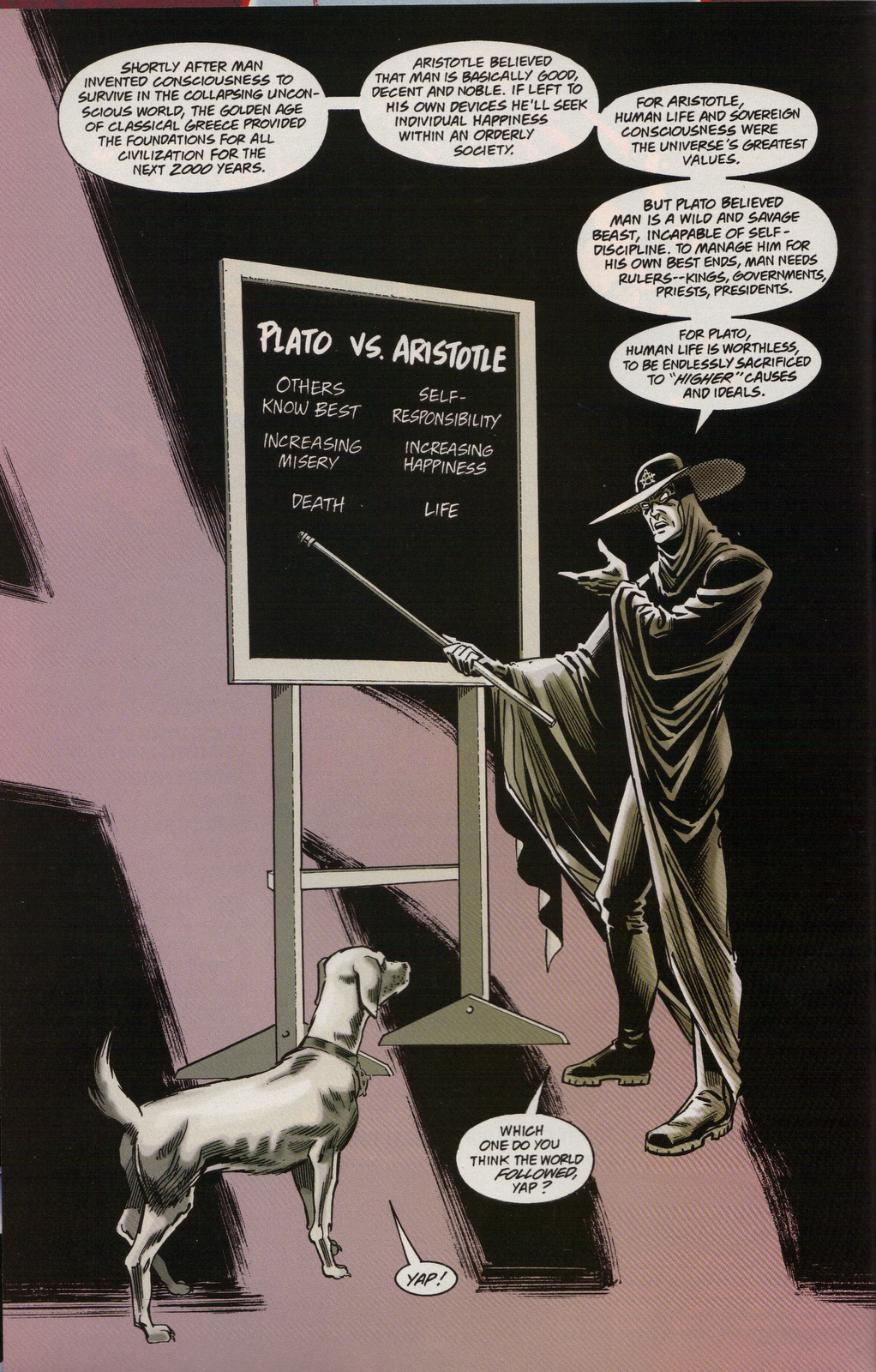
As a BScEcon graduate I love this stream of political thought, discussion and activism. I especially enjoyed the issues own political history lecture (to which are all featured throughout this Blog, for you to enjoy in their subversive glory), which pop up almost like one page adverts halfway through the issue (and are presented here so you too can be fully subverted!). Because these lectures are not needed for the plot, it is simple to suggest that these are Alan Grant's lectures to his readership about his interpretation of the real world. By getting Anarky to break through 'the Forth Wall' (as they say in the TV-land) and using a dog as another audience member (the dog is like the reader, you see, whom Anarky would perceive as also being led by the leash). Basically Alan Grant dares the reader to question his/her own knowledge, and in doing so wishes to then enlighten the reader. That is why there is 'suggested reading' after every issue. You know a writer is as serious as a heart-attack when he dishes out homework at the end of comic book! To get away with something this bold and preachy, yet make the whole work very easily enjoyable, is the proof that Alan Grant really is a truly great writer.

The age of the character is also very interesting, While Alan Moore's 'V' is a grown man, 'Anarky' is a teenager. Why is this important? The use of young characters has been important for publishers as it helped link a character with a key demographic audience. For example, the basic idea of Robin (and all the other superhero kid-sidekicks that came after), was that a young readership would relate to that character, and therefore bond on an emotional level with the title if they could see readers the same age involved in the adventure. Once this relationship is established, then a loyal, specifically targeted, readership will follow. The target audience of the 1990's Batman comic seems to have been male teenagers (for example, Robin #3: “the teen wonder”), it therefore follows that the audience ought to be reading about characters their own age, which Anarky clearly is. Anarky is also made more important, and dangerous, because he engages the full attention of Batman (and, therefore not reduced to merely being Robin canon fodder, as would be the logical use of the character), and that he is a fully switched-on political activist at only fifteen years old. And that says a lot of where what Alan Grant wanted to do with the character's creation. He had designed a teenage character that was saying to a teenage audience 'everything you think you know is a lie' and that there are other political solutions to governance than what you are originally, or indeed are being, taught... Trust me, if Alan Grant tried this in the 1950's or early sixties, I'm sure that the wiry Scot would be hounded out of the industry by politicians with pitchforks.

Now, I want to tell you why I love these books. I seriously do not believe that this comic would be published today (less than 15 years later). And I think the proof for this statement is to look at the uproar created in the US regarding Captain America #602 'Teabag the Tea Party' caption. If this story was published today in Batman I'm sure that FOX News, and those of a similar political persuasion would be demanding that this be pulped, on the grounds that this is way too subversive for teenage boys. I was a teenage boy when I first came across Anarky in Batman. And I can categorically say... It is.

Tuesday, 16 August 2011

Easter Eggs all over Gotham City


Okay, Easter Egg time.

This is the map of Gotham City that appears in No Man's Land #1.

If you want to read the entire, fascinating story of how it was commissioned I recommend that you visit Eliot R. Brown's site, as he was the evil mastermind that drew it. And, frankly, his shots of the map are miles better than mine.

A couple of things to note here, the names of all the streets, the buildings. If you care about nods to Batman's writers, artists and editors then this is a big, fat, melting pile of chocolate Easter Egg!

I'm quite fond of maps, which I'll admit is a bit strange, so I love this. I certainly love the tributes to Alan Grant, Chuck Dixon and Doug Moench, especially as their tenure of being the key 1990's writing team in Gotham was just about ending.

One thing definitely appear to be missing: No Cauldron. This is the particularly nasty area of Gotham where, according to the 60 issue run of 'Hitman', was where all the Irish migrants moved to. Of course, it's omission begs the question: Has this map effectively ret-conned out Ennis & McRea's Tommy 'Hitman' Monaghan from Gotham City folklore?

Friday, 12 August 2011

Crossovers: Batman/Spawn: War Devil


In comics when a successful crossover occurs, there is always a sequel just begging to be released.

In the case of Batman and Spawn there was less a sequel and more of a return match.

The first Spawn/Batman was a regular comic superstar-slug-fest. Miller and McFarlane took two characters that were synonymous with their comic creating endeavours, whacked the volume up to eleven and probably bought new cars with this very Image-like outcome (and I mean that in a good way).

'War Devil' definitely is not an Image book, this is a DC comic and it involved the holy writing trinity of 1990's Batman: Doug Moench, Chuck Dixon and Alan Grant (art was by Klaus Janson, a note of interest as he was involved with Frank Miller's DKR project). I can only assume Moench got top billing because he did the majority of the writing on this book. Anyway, there were a few ways this book could have gone...

This is a book that healthily sums up all of the various ideas and themes throughout the Trinities work. Hokum, for sure, but this was the 1990's and this stuff was always interesting. So what themes and concepts have we got? Satanism, Conspiracy Theories, Tyrannical Moguls, Buildings as Symbols of Power. All the big budget tricks are here: Historical mysteries, Pentagrams carved into Gotham and Assassinations. We've got a walking army of skeletons, Transforming demons. Oh, and fire, a lot of hellfire.

Like the Miller/McFarlane prequel, this has been written as a simple, fun one shot that had no basis on continuity or achieves any bigger purpose (hell, they even totally ignore the other book). It's a horror tale, pure and simple. But what it does do is actually make Al 'Spawn' Simmons a more rounded character, and a man dealing with the mistakes, or decisions of his own past. Spawn, here is dealing with his demons, because he works for demons, and is indebted to demons, it is only natural that he hopes to overcome these demons.

There could be more blatant finger-wagging by Moench, Dixon and Grant at the Image-creation (or indeed the path Image Comics were taking the industry), but they don't do it. However, there is a feeling of one-upmanship here; at it's heart they've taken MacFarlane's creation, added a proper grown up story arc and added character development to Al Simmons that 'Spawn', as a comic title, always promised in the 1990's but never delivered upon. Indeed this story doesn't actually need Batman at all, and he only really is there to deliver this line at the end:

“Good and evil are not determined by the intercourse of people with one another, but entirely by a man's relationship with himself”. For me, it's like Moench et al are using Batman to say to Image you've got a cool character here that can really go places, don't mess it up!

The book ends with hope. Spawn can successfully achieve redemption by doing the right thing, and in (a comic book way) doing so become a proper superhero that is personified by Batman. As Batman jumps off into the Gotham night, it's almost as if Spawn is straining himself not to follow him. And that is significant in itself.